D J
·shared a media post in group #A Glance of China 行摄中国
Seems more relevant than ever, doesn’t it? #🖼📷Art
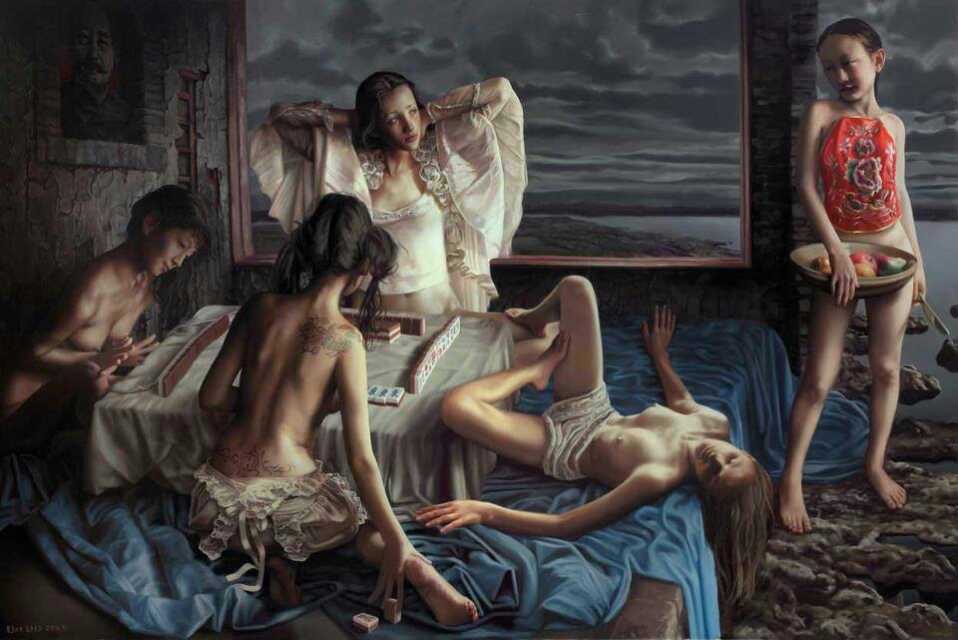
"Amazing thought-provoking painting "Beijing 2008" by Chinese-Canadian
artist Liu Yi.
The woman with the tattoos on her back is China. On the left, focused
intensely on the game, is Japan. The one with the shirt and head
cocked to the side is America. Lying provocatively on the floor is
Russia. And the little girl standing to the side is Taiwan.
This painting, named “Beijing 2008”, has been the subject of much
discussion in the west as well as on the internet. What’s interesting
is that this painting is called “Beijing 2008”, yet it depicts four
women playing mahjong, and conceals a wealth of meaning within…
China’s visible set of tiles “East Wind” has a dual meaning. First, it
signifies China’s revival as a world power. Second, it signifies the
military might and weaponry that China possesses has already been
placed on the table. On one hand, China appears to be in a good
position, but we cannot see the rest of her hand. Additionally, she is
also handling some hidden tiles below the table.
America looks confident, but is glancing at Taiwan, trying to read
something off of Taiwan’s expression, and at the same time seems to be
hinting something at Taiwan.
Russia appears to be disinterested in the game, but this is far from
the truth. One foot hooks coyly at America, while her hand passes a
hidden tile to China, both countries can be said to be exchanging
benefits in secret. Japan is all seriousness while staring at her own
set of tiles, and is oblivious to the actions of the others in her
self-focused state.
Taiwan wears a traditional red slip, symbolizing that she is the true
heir of Chinese culture and civilization. In one hand she has a bowl
of fruit, and in the other, a paring knife. Her expression as she
stares at China is full of anger, sadness, and hatred, but to no
avail; unless she enters the game, no matter who ends up as the
victor, she is doomed to a fate of serving fruit.
Outside the riverbank is darkened by storm clouds, suggesting the high
tension between the two nations is dangerously explosive. The painting
hanging on the wall is also very meaningful; Mao’s face, but with
Chiang Kai Shek’s bald head, and Sun Yat-Sen’s mustache.
The four women’s state of undress represent the situation in each
country. China is naked on top, clothed with a skirt and underwear on
the bottom. America wears a bra and a light jacket, but is naked on
the bottom. Russia has only her underwear left. Japan has nothing
left.
At first glance, America appears to be most composed and seems to be
the best position, as all the others are in various states of
nakedness. However, while America may look radiant, her vulnerability
has already been exposed. China and Russia may look naked, yet their
key private parts remain hidden.
If the stakes of this game is that the loser strips off a piece of
clothing, then if China loses, she will be in the same state as Russia
(similar to when the USSR dissolved). If America loses, she also ends
up in the same state as Russia. If Russia loses, she loses all. Japan
has already lost everything.
Russia seems to be a mere “filler” player, but in fact is exchanging
tiles with China. The real “filler” player is Japan, for Japan has
nothing more to lose, and if she loses just once more she is
immediately out of the game.
America may look like she is in the best position, but in fact is in a
lot of danger, if she loses this round, she will give up her position
as a world power. Russia is the most sinister, playing along with both
sides, much like when China was de-occupied, she leaned towards the
USSR and then towards America; as she did not have the ability to
survive on her own, she had to weave between both sides in order to
survive and develop.
There are too many of China’s tiles that we cannot see. Perhaps
suggesting that China has several hidden aces? Additionally China is
also exchanging tiles with Russia, while America can only guess from
Taiwan’s expression of what actions have transpired between Russia and
China. Japan on the other